AI Automation
How to Rank in Google AI Overviews
AI Overviews now appear above the organic results for a growing share of searches, and they answer the question before anyone scrolls. For informational queries this has already changed the economics of ranking: position one below an Overview earns fewer clicks than position three did two years ago.
Being cited inside the Overview is now the position worth having. Here is what actually determines that.
Where AI Overviews source their answers
Google generates Overviews from its own index, drawing predominantly on pages that already rank for the query or closely related ones. That is the crucial difference from ChatGPT: traditional SEO still matters here, because you generally have to be in the retrievable set before you can be cited.
Within that set, Google favours passages that directly answer the question, come from a source it considers trustworthy on the topic, and can be lifted cleanly without ambiguity. Long preambles get skipped. Specific, self-contained statements get quoted.
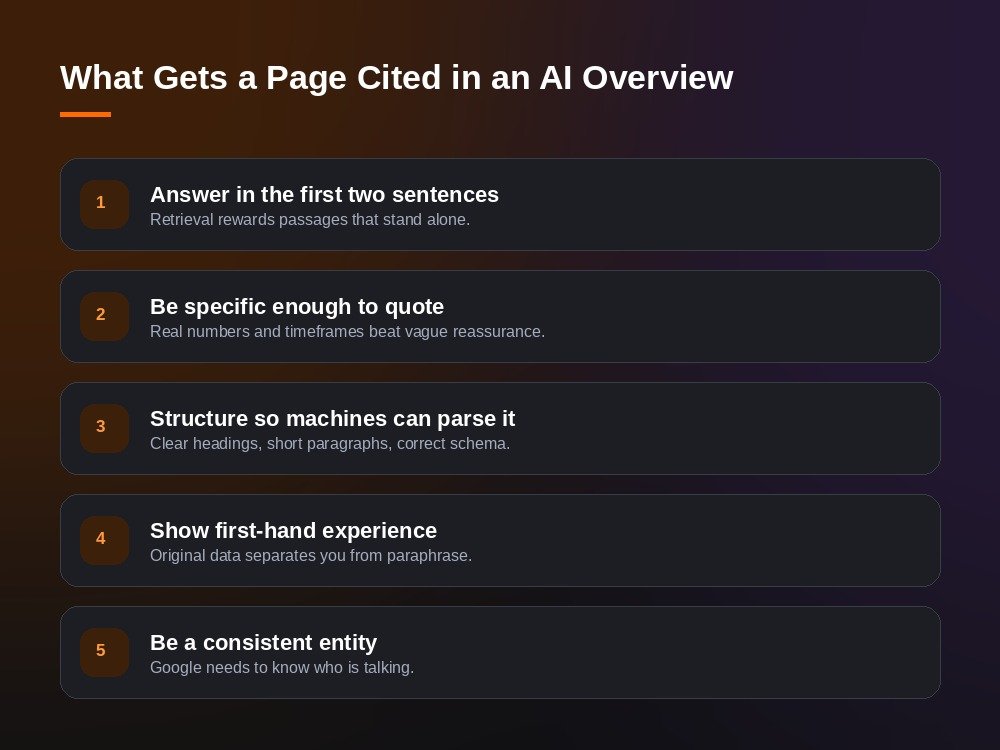
What gets a page cited
Answer the question in the first two sentences
If a section is headed with a question, the answer should follow immediately, not after three sentences of context. Retrieval systems reward passages that stand alone. Write the conclusion first and the reasoning after.
Be specific enough to be worth quoting
“Costs vary depending on your requirements” is unquotable. “Google Ads management in Dubai typically starts around AED 3,500 per month for a single-channel account” is quotable, checkable and useful. Vagueness is the enemy of citation.
Structure so the machine can parse you
Clear H2 and H3 hierarchy, one idea per section, short paragraphs, lists where the content is genuinely a list. Add FAQPage schema on question content and Article schema on guides. Structured data does not force a citation, but it removes ambiguity about what your content is.
Demonstrate first-hand experience
Google’s guidance on helpful content leans hard on experience. Original data, real numbers from work you did, screenshots, and honest specifics all separate you from paraphrased summaries of everyone else’s articles. If your page only restates what the top ten already say, there is no reason to cite it.
Be consistent as an entity
Google needs to know who is talking. Consistent author information, a real About page, Person and Organisation schema, and the same details across your properties all help it associate your content with a recognised entity rather than an anonymous page.
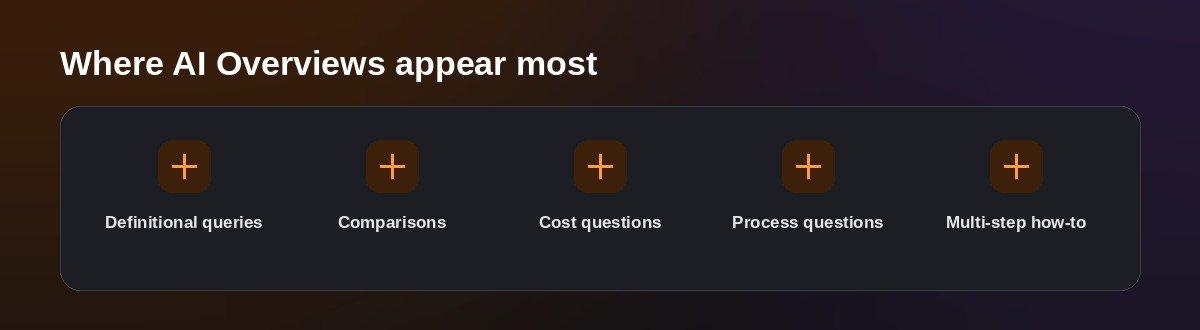
The query types where Overviews appear most
- Definitional: what is X, how does X work
- Comparative: X vs Y, best X for Y
- Cost and process: how much does X cost, how long does X take
- Multi-step how-to: how to do X
They appear far less on transactional and navigational queries, which is worth knowing: your money pages are less exposed than your blog.
What it does to your traffic, honestly
Two effects run in opposite directions. Informational queries lose clicks, because the Overview answers them. But being cited inside an Overview lends visible authority, and users who do click through after reading a citation tend to arrive better qualified.
The strategic response is not to abandon informational content. It is to shift the balance: keep publishing the answers that earn citations and brand recognition, and make sure your commercial pages, where Overviews are rarer, are strong enough to convert the traffic that still arrives.
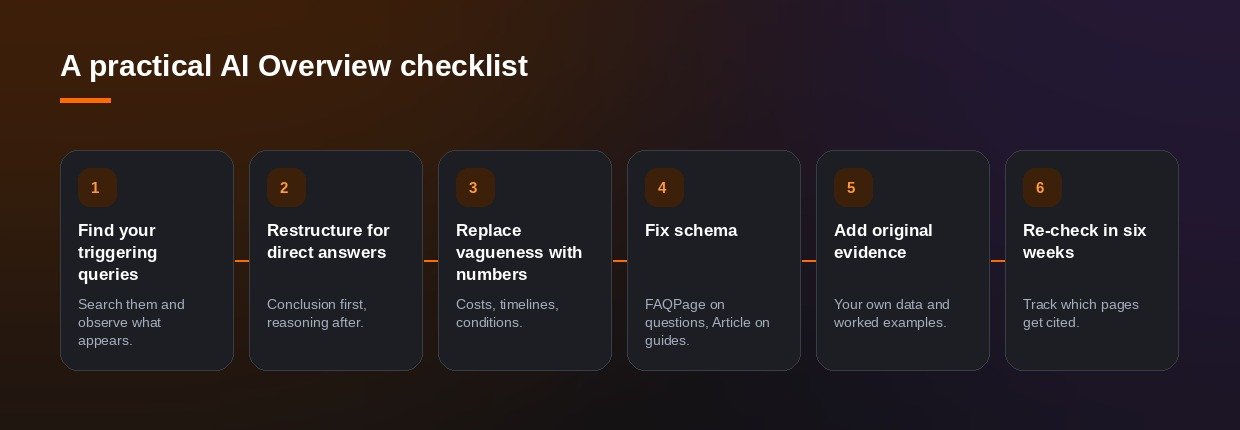
A practical checklist
- Identify your queries that currently trigger an Overview, by searching them and observing
- Restructure those pages so each section opens with a direct answer
- Replace vague statements with specific numbers, timeframes and conditions
- Add or fix FAQPage and Article schema
- Add original evidence: your own data, screenshots, results, worked examples
- Make author and entity information explicit and consistent
- Re-check after four to six weeks and track which pages get cited
Frequently asked questions
Do I need to rank on page one to appear in an AI Overview?
Usually you need to be in the retrievable set for the query, which in practice means ranking reasonably well for it or something close to it. Overviews sometimes cite pages outside the top ten, but relying on that is not a strategy.
Do AI Overviews reduce my traffic?
For informational queries, generally yes. For commercial and transactional queries, far less, because Overviews appear less often there. Measure the split before drawing conclusions about your own site.
Does schema markup guarantee citation?
No. Schema clarifies what your content is, which helps retrieval, but the citation decision depends on relevance, clarity and trust. Schema is necessary hygiene rather than a lever.
How is this different from optimising for ChatGPT?
AI Overviews run inside Google’s index, so classic SEO still applies. ChatGPT browses Bing and leans more on third-party corroboration and listings. The content principles overlap, the distribution work does not.
Related services
Get named by ChatGPT, Perplexity and Gemini
Six practical guides on becoming the business AI recommends, and the service that does it for you.
Generative Engine OptimizationDone for you: listings, entity work and citable content→Work with me
Let’s find the money you’re leaving on the table.
Tell me where growth feels stuck. Within one working day you’ll have my honest read on what’s leaking, what it’s costing you, and whether I’m the right person to fix it. No pitch deck, no pressure.
Performance marketing consultant for clinics and DTC brands across Dubai and the UK. Paid media, landing pages, tracking and creative, accountable to revenue.
Leave a Reply