AI Automation
How to Get Your Business Listed in AI Answers: ChatGPT, Perplexity and Gemini
People talk about AI visibility as one thing. It is four things with different mechanics. ChatGPT, Perplexity, Gemini and Copilot each assemble answers from different sources, which means work that gets you named in one may do nothing for another.
Here is what each actually uses, and the overlap worth prioritising if you only have time for one push.
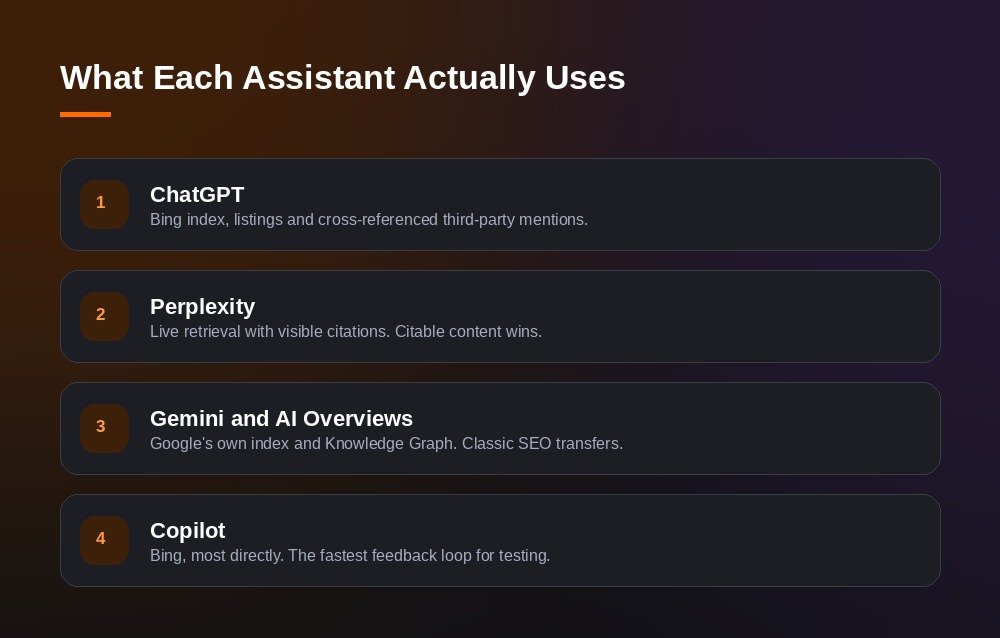
ChatGPT
Sources: training data plus live browsing through Bing, and increasingly cited third-party pages.
What moves it: Bing presence above all. A claimed Bing Places listing, your site indexed properly in Bing Webmaster Tools, consistent business data across platforms, and independent mentions the model can cross-reference.
What does not move it: Google rankings, Google Business Profile, and anything visible only on your own website.
Perplexity
Sources: live web retrieval with visible citations, drawn from multiple search backends, plus a strong preference for pages that read as authoritative on the specific question.
What moves it: genuinely citable content. Perplexity shows its sources, so it favours pages with clear, specific, attributable statements. Original data, real numbers and well-structured answers get picked up faster here than anywhere else. It is also the fastest to reflect new content, which makes it a good early test.
What does not move it: listings and directories carry less weight than for ChatGPT, because Perplexity is answering from documents rather than verifying a business record.
Google Gemini and AI Overviews
Sources: Google’s own index and Knowledge Graph.
What moves it: traditional SEO, essentially. Ranking well for the query or something adjacent, structured data, entity consistency, and a well-established Google Business Profile for local queries. This is the one place where your existing SEO investment transfers directly.
Microsoft Copilot
Sources: Bing, most directly of all.
What moves it: everything that moves Bing. Copilot usually reflects Bing changes before ChatGPT does, which makes it the fastest feedback loop for testing whether your Bing work landed.
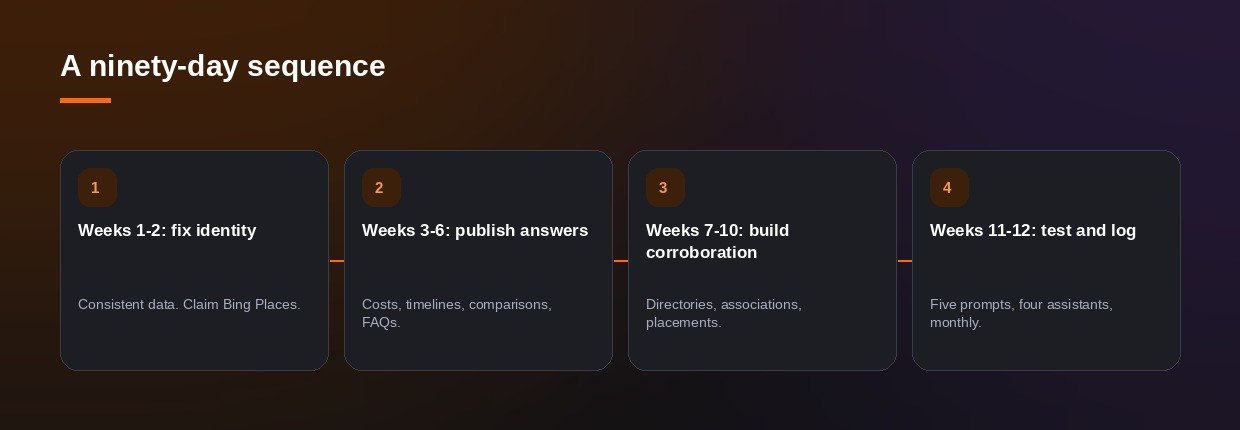
The overlap: what to do first
Four items appear in more than one column. Do these before anything platform-specific.
1. Consistent entity data everywhere
One business name, one phone format, one URL, replicated identically across every listing and profile you hold. This underpins verification for every assistant that checks business records.
2. Answer content with real specifics
Questions your buyers actually ask, answered in plain sentences with numbers, timeframes and honest conditions. This is retrievable by all four, and it is the single piece of work that transfers everywhere.
3. Structured data and a clear entity
Organisation or Person schema, FAQPage on question content, Article on guides, consistent author information. It helps Google directly and removes ambiguity for everyone else.
4. Independent corroboration
Directory listings, association memberships, guest content, podcast appearances, credible roundups. Third-party confirmation is the currency of trust in every one of these systems.
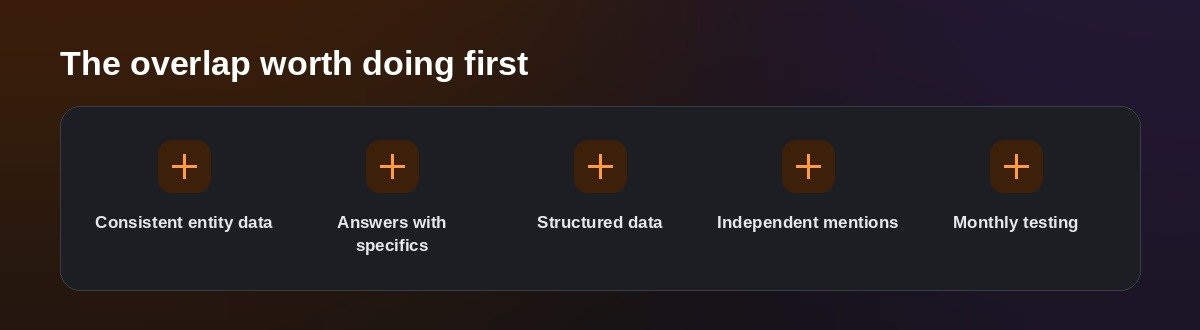
A ninety-day sequence
Weeks 1 to 2: fix entity consistency everywhere it is currently wrong. Claim Bing Places. Add the site to Bing Webmaster Tools and submit the sitemap.
Weeks 3 to 6: publish the answer content: costs, timelines, comparisons, eligibility, an FAQ that mirrors real enquiries. Add schema. This is the heaviest phase and the one that pays across all four platforms.
Weeks 7 to 10: build corroboration. Directories, associations, two or three genuine external placements. Start a review habit if you do not have one.
Weeks 11 to 12: test all four assistants with buyer-language prompts, record what appears, and note which changes preceded any movement.
How to measure it without a tool
Run the same five prompts monthly across all four assistants and log the results in a sheet: were you named, in what position, and alongside whom. Then watch branded search volume in Search Console, because AI mentions often produce a branded search rather than a click. Rising branded search with flat rankings is usually AI doing its work quietly.
Frequently asked questions
Which assistant should I prioritise?
ChatGPT for reach, because it has the largest user base, which makes Bing work the priority. Perplexity for speed of feedback, because it reflects new content fastest.
Can I pay to appear in AI answers?
Not in organic recommendations. Advertising is beginning to appear in some AI surfaces, but recommendation placement itself is not for sale, and anyone offering guaranteed placement is misrepresenting how these systems work.
How long does the whole thing take?
Two to three months for first appearances if you complete the sequence, longer if you start with no listings, no reviews and no external mentions.
Does this replace SEO?
No. Most of it is SEO with a different distribution layer. The technical foundations, content quality and entity work are shared; what changes is where you publish your identity and how you write your answers.
Related services
Get named by ChatGPT, Perplexity and Gemini
Six practical guides on becoming the business AI recommends, and the service that does it for you.
Generative Engine OptimizationDone for you: listings, entity work and citable content→Work with me
Let’s find the money you’re leaving on the table.
Tell me where growth feels stuck. Within one working day you’ll have my honest read on what’s leaking, what it’s costing you, and whether I’m the right person to fix it. No pitch deck, no pressure.
Performance marketing consultant for clinics and DTC brands across Dubai and the UK. Paid media, landing pages, tracking and creative, accountable to revenue.
Leave a Reply