AI Automation
Why ChatGPT Recommends Your Competitor Instead of You
You ask ChatGPT to recommend a specialist in your category and your competitor gets named. You know your work is better, your results are stronger, your site is nicer. None of that is what the model evaluated.
AI recommendation is not a quality judgement. It is a confidence judgement. The model is trying to name businesses it can verify exist, operate and match the request, using the sources available to it. Your competitor is not winning because they are better. They are winning because they are easier to confirm.
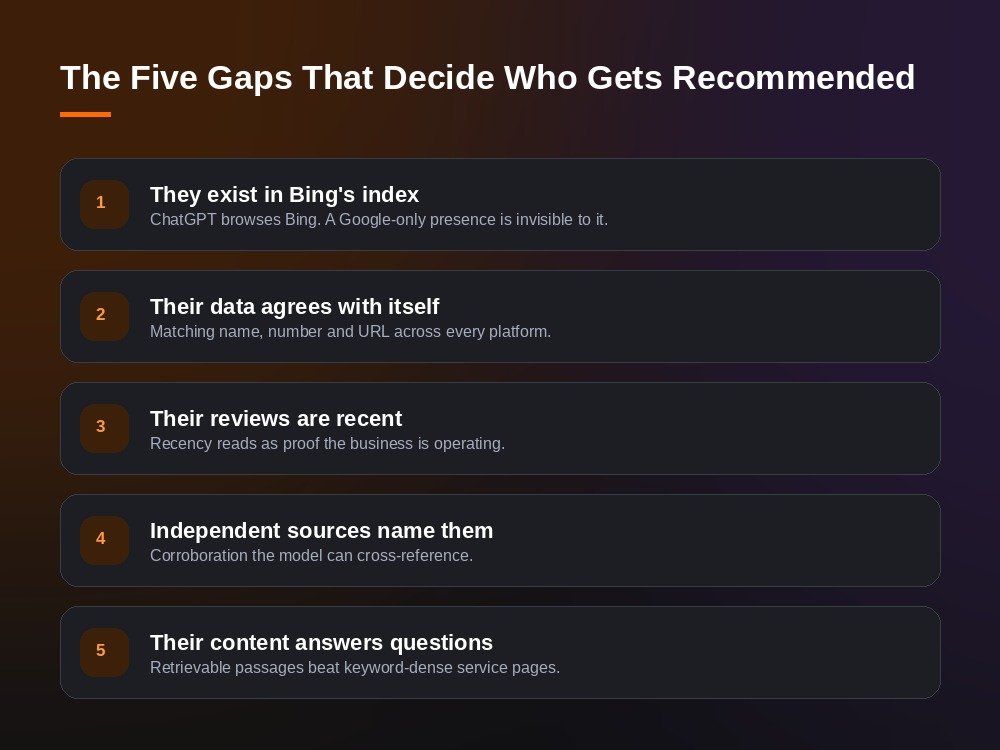
The five gaps that decide it
1. They exist in Bing’s index and you barely do
ChatGPT’s live browsing runs on Bing. Most businesses have optimised entirely for Google and have never checked how they appear in Bing, never claimed Bing Places, and have thin coverage in that index. If Bing does not have a confident picture of you, ChatGPT has nothing to pull.
2. Their business data agrees with itself
Your competitor’s name, phone number and website match across every platform they appear on. Yours might vary slightly: a different trading name here, an old number there, http instead of https somewhere else. Each inconsistency reduces the model’s confidence that these records describe one business, and low confidence means omission.
3. They have recent reviews and you have old ones
Recency does more work than volume in AI recommendation, because it functions as a proof of life. A competitor with reviews from this month looks operating. A business whose newest review is eighteen months old looks like a risk to recommend.
4. Independent sources mention them
They appear in directories, association lists, industry roundups, local press, podcast notes. Each is an independent confirmation. You may appear only on your own website and one profile, which gives a model no corroboration at all. Self-published claims are the weakest possible evidence.
5. Their content answers questions and yours sells services
Language models retrieve passages that answer the question asked. A page that says “typical cost, timeline and what is included” in plain sentences is retrievable. A page built around keyword repetition and benefit statements is not. Ironically, aggressive traditional SEO often makes a site worse at being cited by AI.
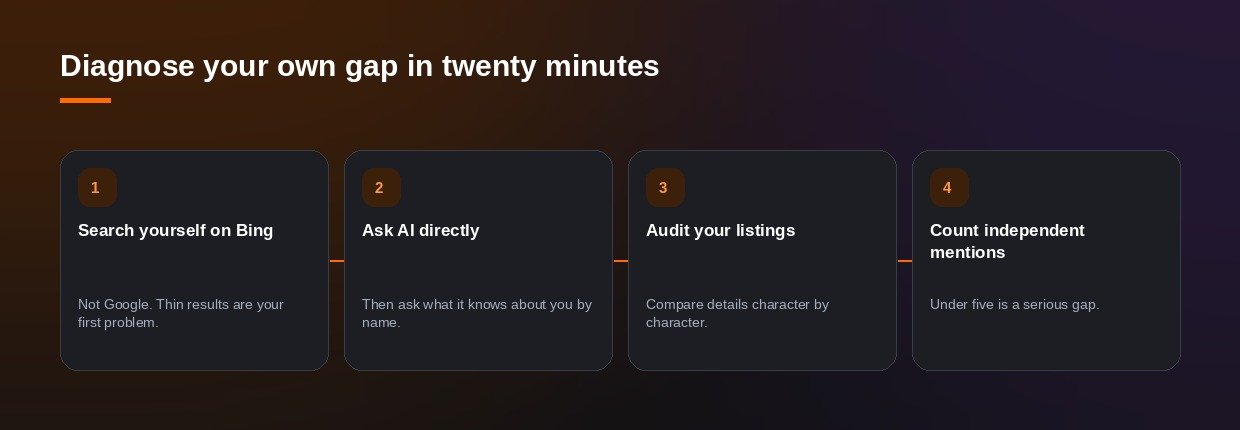
How to diagnose your own gap
Run these four checks in order. They take about twenty minutes and they will tell you exactly which of the five gaps is yours.
Check one: search yourself on Bing. Not Google, Bing. If your results are thin, outdated or absent, that is your primary problem and nothing else matters until it is fixed.
Check two: ask AI directly, then ask why. Ask for recommendations in your category and city. When competitors are named, ask the model what sources it used and what it knows about your business by name. The answers are imperfect but they reveal what it can and cannot verify.
Check three: audit your own listings. List every platform where your business appears and compare name, phone, address and URL character by character. Most businesses find at least three inconsistencies.
Check four: count independent mentions. Search your business name in quotes and count results that are not your own properties. Under five is a serious gap. Your competitor probably has fifteen.
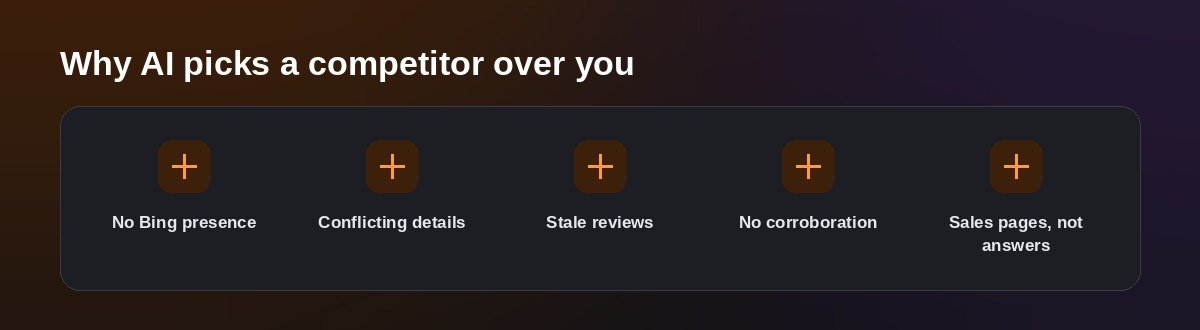
Closing each gap
The Bing gap. Claim Bing Places, complete every field, and submit your sitemap to Bing Webmaster Tools. Almost nobody does the second part, and it directly affects how well Bing understands your site.
The consistency gap. Choose one canonical version of your business details and enforce it everywhere. Fix, do not add, first.
The recency gap. Build a habit of asking for a review at the natural moment of satisfaction, and respond to each one. Two or three a month sustains the signal.
The corroboration gap. Get listed on the credible directories in your industry, join the relevant association, contribute to one roundup or podcast per month. Ten independent mentions changes the picture materially.
The content gap. Publish genuine question and answer content with specifics: costs in real numbers, timelines in real weeks, honest constraints. Add FAQ schema. This is also the content that converts human readers, so it pays twice.
What this looks like ninety days later
Businesses that close the listing and consistency gaps typically begin appearing in AI answers within two to three months. The order tends to be predictable: first you appear when asked directly by name, then in longer more specific queries, then in short competitive prompts like “best X in Y”. If you are not being named for your own brand yet, that is where to start.
Frequently asked questions
Is my competitor paying to appear in ChatGPT?
No. ChatGPT recommendations are not a paid placement. If a competitor appears consistently, it is because their presence is easier to verify across the sources the model uses.
Does having a better website help?
Better in the design sense, no. Better in the answers sense, significantly. A plain page that answers real questions with specifics outperforms a beautiful page of marketing language for AI citation.
How often should I re-test?
Monthly. AI answers vary between sessions, so test the same prompts a few times and look at the pattern rather than a single result.
Does this apply to Perplexity and Gemini too?
The underlying logic does: verifiable, corroborated, citable. The sources differ, with Perplexity leaning on live citations and Gemini leaning on Google’s understanding of entities, so the work overlaps but is not identical.
Related services
Get named by ChatGPT, Perplexity and Gemini
Six practical guides on becoming the business AI recommends, and the service that does it for you.
Generative Engine OptimizationDone for you: listings, entity work and citable content→Work with me
Let’s find the money you’re leaving on the table.
Tell me where growth feels stuck. Within one working day you’ll have my honest read on what’s leaking, what it’s costing you, and whether I’m the right person to fix it. No pitch deck, no pressure.
Performance marketing consultant for clinics and DTC brands across Dubai and the UK. Paid media, landing pages, tracking and creative, accountable to revenue.
Leave a Reply